

For most people leaving a job, the best move is a direct rollover of the old 401(k) into a traditional IRA or your new employer’s plan. That keeps the money invested and avoids the taxes and potential 10% early-withdrawal penalty that can turn a $30,000 retirement account into far less. Learning how to roll over a 401k matters because one bad paperwork choice can trigger mandatory withholding and a tight 60-day deadline.
You do not have to move the money immediately. You can often leave it in the former employer’s plan, and sometimes that is the smarter choice. But do not confuse “I can leave it there” with “I should ignore it.” Compare fees, investment options, withdrawal rules, and your own tax situation before deciding.
Contents
- 1 Start With the Four Choices You Actually Have
- 2 Make Smarter Money Moves
- 3 How to Roll Over a 401k Without Creating an Avoidable Tax Bill
- 4 Choose Between an IRA, a New Plan, and the Old Plan
- 5 Do Not Accidentally Give Up the Rule of 55
- 6 Understand the Tax Traps Before You Sign Distribution Forms
- 7 A Worked Example: Direct Rollover Versus Cashing Out $40,000
- 8 Use This Paperwork Checklist to Complete the Transfer
- 9 What a Rollover Does Not Affect
- 10 Frequently Asked Questions
- 10.1 Do I have to roll over my 401(k) after leaving a job?
- 10.2 Can I roll a 401(k) into a Roth IRA?
- 10.3 How long do I have to move the money?
- 10.4 Can I roll my old account into my new employer’s 401(k) right away?
- 10.5 Will a rollover hurt my credit score?
- 10.6 What happens if I receive a check made out to me?
- 11 Make the Choice, Then Use a Direct Transfer
Start With the Four Choices You Actually Have
After you leave an employer, your account balance does not disappear. You generally have four paths: leave it where it is, move it to a new workplace plan, roll it into an IRA, or take the money as cash. The first three can preserve the account’s tax-deferred status; the fourth usually creates a tax bill.
| Option | Usually best for | Main advantage | Main drawback |
|---|---|---|---|
| Leave money in old 401(k) | People with excellent low-cost funds or access to the Rule of 55 | No paperwork now; may preserve special withdrawal access | Another account to monitor; former employer can change the plan |
| Roll into new employer’s plan | People who want consolidation and a solid new plan | One workplace account; may help preserve backdoor Roth IRA flexibility | New plan must accept rollovers and may have limited investments |
| Roll into a traditional IRA | Most people who want broad investment choice and control | Usually the widest selection of funds, ETFs, bonds, and providers | Can complicate backdoor Roth contributions and removes Rule of 55 access |
| Cash out | Rare emergencies after every other source is exhausted | Immediate access to money | Income taxes, possible 10% penalty, and permanent loss of retirement growth |
My general preference is simple: use a traditional IRA if you want low-cost investment choices and do not expect to need the money before age 59½. Use the new employer’s plan if it has good funds and low fees, especially if you may use the backdoor Roth IRA strategy later. Leave the old plan alone if its fees are low and the Rule of 55 could matter to you.
Cashing out should be the last resort, not the default choice because you changed jobs. A retirement account is not merely a savings account with inconvenient paperwork. It is money that has years or decades to compound without annual taxes on dividends, interest, or capital gains.
How to Roll Over a 401k Without Creating an Avoidable Tax Bill
The safest method is a direct rollover, sometimes called a trustee-to-trustee transfer. Your old plan sends the funds directly to the receiving IRA provider or new employer plan. You never take possession of the money.
That distinction matters. If the former plan makes the check payable to your IRA custodian “for your benefit,” it is generally still a direct rollover. For example, a check payable to “Fidelity Management Trust Company FBO Jane Smith” can be forwarded to Fidelity without being treated as a cash distribution to Jane.
Confirm that the receiving account is ready first
Do not call the old plan and request a distribution until you know where the money is going. Open the traditional IRA first, or contact the new plan administrator to confirm that the plan accepts incoming rollovers. Many plans do, but they are not required to.
Ask the new plan administrator for its rollover instructions. You may need an account number, a letter of acceptance, a rollover form, or mailing instructions. If the plan uses a recordkeeper such as Vanguard, Fidelity, Empower, Principal, or Alight, the recordkeeper’s website may show the process, but call if anything is unclear.
Request a direct rollover, not a distribution payable to you
Tell the former plan administrator that you want a direct rollover of the pre-tax balance to a traditional IRA or eligible employer plan. If you have Roth 401(k) money, request that portion be rolled directly to a Roth IRA or to the Roth account in a new employer plan that accepts it.
Keep the tax types separated. Pre-tax 401(k) dollars belong in a traditional IRA or pre-tax workplace account. Roth 401(k) dollars generally belong in a Roth IRA or Roth workplace account. Moving pre-tax money into a Roth IRA is a Roth conversion, which means the pre-tax amount becomes taxable income for that year.
Verify the transfer and invest the cash
A rollover is not complete just because the old plan shows a zero balance. Confirm the receiving account received the right amount, including any Roth and after-tax subaccounts. Then check what the money is invested in.
This is a surprisingly common failure point: money arrives in an IRA and sits in a settlement fund earning a modest cash yield for years. Pick investments that match your time horizon and risk tolerance. If you are decades from retirement, a diversified target-date index fund or a simple diversified stock-and-bond mix may be more appropriate than leaving the entire balance in cash. For help comparing common investment building blocks, read Index Funds vs. ETFs: Key Differences for Beginning Investors.
Choose Between an IRA, a New Plan, and the Old Plan
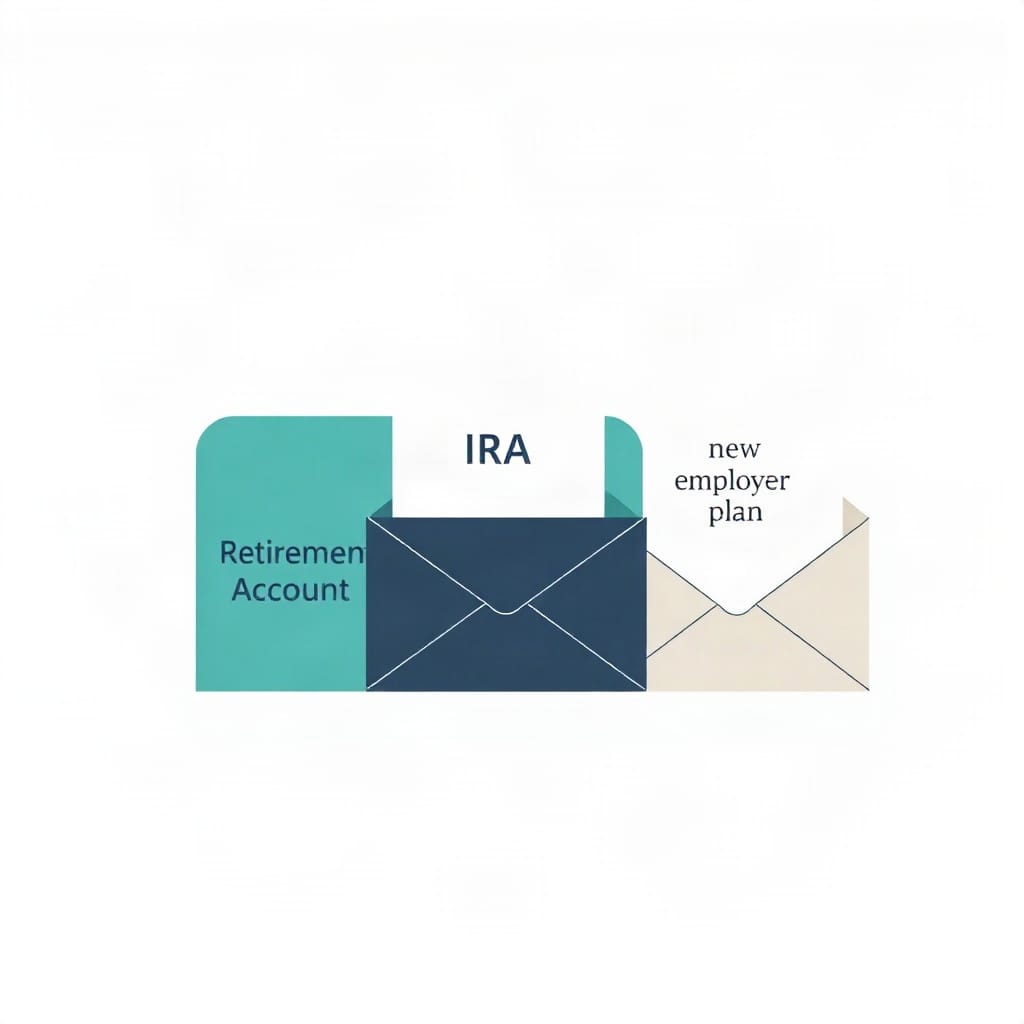
The right destination is not automatically the account with the most familiar name. Compare the actual plan documents, fund expenses, service fees, and rules before moving a dollar.
A traditional IRA: usually the best default for control
A rollover IRA can be opened at a brokerage firm, bank brokerage division, mutual fund company, or robo-advisor. At a mainstream low-cost brokerage, you can generally choose from broad-market index funds, ETFs, Treasury securities, individual bonds, and target-date funds. That is a much wider menu than most 401(k) plans offer.
Look beyond whether an account advertises “no account fee.” Investment costs still matter. A broad index fund might charge an expense ratio around 0.03% to 0.10%, while actively managed funds, annuity products, managed-account services, or high-cost specialty funds can run 0.75% to 1% or more annually. On a $100,000 account, a 1% annual fee is about $1,000 in the first year alone.
An IRA is especially appealing if your old plan charges a separate quarterly administrative fee, offers expensive funds, or makes it hard to see what you own. But IRAs are individual accounts, not employer plans. Creditor-protection rules can differ by state outside bankruptcy, and you lose certain workplace-plan features discussed below.
A new employer plan: best for consolidation and certain tax strategies
Rolling old money into a new 401(k) gives you one account to manage and can simplify future required minimum distribution planning. More importantly, it can preserve a clean traditional IRA balance for people who use the backdoor Roth IRA strategy.
Here is the non-obvious issue: the IRS looks at the combined value of all your traditional, SEP, and SIMPLE IRAs when you convert money to a Roth IRA. It does not let you isolate only the nondeductible contribution you just made. If you expect to make backdoor Roth contributions because your income is too high for direct Roth IRA contributions, moving old pre-tax 401(k) money into a traditional IRA can create a pro-rata tax problem.
If your new 401(k) accepts inbound rollovers, moving the old pre-tax balance there instead may avoid that complication. This is one reason high earners often prefer the new employer plan even when an IRA has better investment choices. For the basic differences between Roth and pre-tax IRA treatment, see Roth vs traditional IRA: Which Retirement Account Fits?.
Do not assume the new plan is good just because it is convenient. Read the fund lineup and fee disclosure. If the cheapest U.S. stock fund costs 0.80%, the plan has a 0.50% annual administration charge, and the only bond options are mediocre, convenience may not be worth the price.
Leaving funds in the former plan: sometimes the most strategic choice
Former employees can often keep a balance in the old plan, particularly if the account is above the plan’s minimum balance threshold. This makes sense if the plan has exceptionally inexpensive institutional share classes, stable-value funds you cannot get in an IRA, strong creditor protections, or a valuable early-withdrawal feature.
Read the plan’s summary plan description rather than relying on what a former coworker says. Some plans charge former employees additional administrative fees, restrict installment withdrawals, or make it harder to get help after you leave. Others are excellent and cost less than comparable IRA investments.
Also watch small balances. Under federal rules, a plan may generally force out a former employee’s small balance under its plan terms. For balances above $1,000 and up to $7,000, a plan can generally transfer the money to an automatic rollover IRA rather than send a check. Those default IRAs may use conservative investments and charge fees, so do not overlook mail from your former plan.
Do Not Accidentally Give Up the Rule of 55
If you may need retirement money in your 50s, keeping funds in the employer plan you are leaving can be far better than rolling them to an IRA. This exception is one of the biggest reasons not to rush a rollover.
The Rule of 55 generally allows penalty-free withdrawals from the 401(k) of the employer you separated from during or after the calendar year you turn 55. The distributions are still generally taxable if they come from pre-tax money, but the usual 10% additional tax on early distributions may not apply. Certain public-safety employees can qualify beginning in or after the year they turn 50.
The rule does not generally apply to an IRA. It also does not open every 401(k) you have ever held. It applies to the plan of the employer from which you separated, subject to the plan allowing the withdrawals. If you roll that account into an IRA at age 55, you can lose this access route.
Example: Maria leaves her employer in October of the year she turns 55. She has $180,000 in that employer’s 401(k), wants to work part-time, and may need $20,000 a year before age 59½. Leaving enough money in the old plan to cover those withdrawals could avoid early-distribution penalties. Moving the entire balance to an IRA may be a costly mistake.
That does not mean everyone age 55 should leave everything behind. It means you should decide before the rollover, not after. The IRS outlines rollover and distribution rules in its rollover guidance for retirement plans and IRAs.
Understand the Tax Traps Before You Sign Distribution Forms
Most rollover errors come from treating a distribution form like routine HR paperwork. Slow down when you see terms such as “lump-sum payment,” “withholding election,” “eligible rollover distribution,” or “Roth conversion.”
The 20% withholding problem
If a plan pays an eligible rollover distribution directly to you, it generally must withhold 20% for federal income taxes. The withholding does not mean you owe exactly 20% in tax. It is simply money sent to the IRS in advance.
You normally have 60 days to roll over the full gross distribution, not just the check you received. To complete the rollover, you must replace the withheld amount from other savings. If you do not, the withheld portion is generally treated as a taxable distribution and may also face the 10% additional tax if you are under 59½ and no exception applies.
This is why the safest version of how to roll over a 401k is nearly always a direct rollover. It avoids the withholding scramble entirely.
Roth, after-tax, and employer stock need extra care
Many 401(k)s contain more than one tax bucket. Roth contributions, pre-tax salary deferrals, employer matching contributions, and voluntary after-tax contributions may each have different treatment. Ask for a breakdown before initiating the transfer.
Company stock is another special case. If you hold appreciated employer stock in a traditional 401(k), a strategy called net unrealized appreciation may allow favorable tax treatment in limited circumstances when shares are distributed in kind. Rolling those shares automatically to an IRA can eliminate that possibility. This is not a do-it-yourself tax move; ask a qualified tax professional before moving employer stock with a large unrealized gain.
Outstanding plan loans also require attention. If you leave with a loan and do not repay it, the unpaid amount may become a plan loan offset. In some cases related to severance, the deadline to roll over that amount can extend to your federal tax-filing deadline, including extensions, for that year. A regular “deemed distribution” while still employed follows different rules. Get the plan’s written explanation; do not assume every loan balance is rollover-eligible.
A Worked Example: Direct Rollover Versus Cashing Out $40,000
The immediate tax cost of cashing out is painful. The bigger damage is losing future compounding on money that was meant to stay invested.
Illustrative example: Daniel is 38, leaves a job, and has $40,000 in a pre-tax 401(k). He is in the 22% federal income-tax bracket and lives in a state with a 5% income tax. He does not qualify for an early-withdrawal exception.
If Daniel chooses a direct rollover to a traditional IRA, the full $40,000 stays invested. Assume it earns an average 7% annual return for 27 years, until age 65:
$40,000 × (1.07)27 = approximately $248,000.
That future value is not guaranteed, and investment returns will vary. But it shows why keeping retirement money invested matters.
If Daniel cashes out instead, the tax math looks like this:
- $40,000 distribution
- $8,800 estimated federal income tax at 22%
- $2,000 estimated state income tax at 5%
- $4,000 potential early-distribution penalty at 10%
- Estimated amount left: $25,200
Daniel may initially receive only $32,000 because the plan withholds 20%, or $8,000, for federal taxes. But his final tax bill depends on his complete return. At tax time, he could owe more than the $8,000 withheld because his estimated federal tax plus the penalty is $12,800, before state tax.
He has not merely lost $14,800 to taxes and penalties. He has also removed $40,000 from a tax-advantaged account that could have grown to roughly $248,000 under the example assumptions. Cashing out may solve a current crisis, but it should be treated as an expensive emergency option, not a reward for changing jobs.
If debt is the reason you are considering a withdrawal, compare the alternatives first. A 401(k) distribution does not erase the underlying spending problem and can permanently shrink your retirement security. A focused payoff plan may be a better starting point; see Debt Snowball vs. Debt Avalanche: Which Payoff Method Should You Use?.
Use This Paperwork Checklist to Complete the Transfer
A clean rollover is usually straightforward, but it can take one to several weeks depending on the old recordkeeper, the receiving institution, and whether a paper check is involved. Keep a small file until tax season is over.
- Find the old plan details. Locate your account number, the recordkeeper’s phone number, and the latest statement. Your former HR department may be helpful, but the recordkeeper usually processes the transaction.
- Check the balance and account types. Identify pre-tax, Roth, after-tax, company-stock, and loan amounts. Ask whether any portion is not eligible for rollover.
- Choose the destination. Compare the old plan, new plan, and IRA using actual fee disclosures and investment options—not brand names alone.
- Open the receiving account. For an IRA, open the correct registration: traditional for pre-tax assets and Roth for Roth assets. For a new plan, obtain its incoming-rollover instructions.
- Request a direct rollover. Specify the exact payee and mailing address supplied by the receiving institution. Ask if electronic transfer is available.
- Track the check or transfer. If a check is mailed to you payable to the custodian for your benefit, forward it promptly using a trackable method. Do not deposit it in your personal bank account.
- Confirm the deposit and investment election. Check that the total arrived and that it is invested according to your instructions.
- Save tax forms. You will generally receive Form 1099-R from the old plan. A properly completed direct rollover is commonly reported with a distribution code showing that it was rolled over, but still report it correctly on your tax return.
If the account includes a Roth 401(k), do not assume the Roth portion has met the Roth IRA five-year rule. A rollover from a designated Roth account to a Roth IRA can have different holding-period consequences than a Roth IRA you have owned for years. That usually matters only if you expect to withdraw earnings soon, but it is worth documenting.
What a Rollover Does Not Affect
Moving old retirement money is different from making a new annual contribution. A direct rollover generally does not count against your annual 401(k) salary-deferral limit or your IRA contribution limit.
That means you can roll $85,000 from an old 401(k) to a traditional IRA and still make an IRA contribution if you are eligible. Contribution deductibility can depend on your income and workplace-plan coverage, which is separate from rollover eligibility. Review Traditional IRA Contribution Limits and Income Rules for Deductions before assuming a contribution is deductible.
A rollover also does not make the money tax-free. Pre-tax assets remain tax-deferred, meaning ordinary income taxes generally apply when you later withdraw them. Roth assets can potentially be withdrawn tax-free if the applicable age and holding-period requirements are met. The transfer preserves the tax character; it does not erase future taxes.
Finally, do not confuse a rollover with a conversion. A traditional 401(k)-to-traditional IRA transfer is generally not taxable. A traditional 401(k)-to-Roth IRA transfer is generally taxable because you are deliberately moving pre-tax money into a Roth account.
Frequently Asked Questions
These questions cover the issues that tend to come up after you have chosen a destination but before the money actually moves.
Do I have to roll over my 401(k) after leaving a job?
No. Many plans allow former employees to leave their balances in place. However, a plan may force out smaller balances under its rules, and you should continue monitoring fees, investments, beneficiaries, and communications from the former employer.
Can I roll a 401(k) into a Roth IRA?
Yes, but pre-tax 401(k) money moved to a Roth IRA is generally a taxable Roth conversion. Roth 401(k) money can generally be rolled directly into a Roth IRA without creating tax on the rollover itself. Keep the two sources separate on the paperwork.
How long do I have to move the money?
There is usually no universal deadline for a direct rollover after leaving a job, though your plan may eventually require action for a small balance. If the money is paid to you personally, the normal rollover deadline is 60 days. Direct rollovers avoid relying on that deadline.
Can I roll my old account into my new employer’s 401(k) right away?
Possibly. Your new plan must allow incoming rollovers, and some employers impose a waiting period before you can participate. Contact the new plan administrator, not just payroll, to confirm eligibility and request instructions.
Will a rollover hurt my credit score?
No. A retirement rollover is not a credit transaction and is not reported to consumer credit bureaus as a loan, account closure, or payment history event.
What happens if I receive a check made out to me?
Act quickly. The plan will generally withhold 20% from an eligible rollover distribution paid to you. To roll over the full amount, you normally need to deposit the original gross amount into an eligible account within 60 days, replacing the withheld money from other funds. Call the receiving institution for precise deposit instructions.
Make the Choice, Then Use a Direct Transfer
For most job changers, the practical answer to how to roll over a 401k is to open a low-cost traditional IRA or confirm that the new workplace plan accepts rollovers, then request a direct transfer. Before you submit the form, pause if you are age 55 or older, hold employer stock, have a plan loan, or expect to use backdoor Roth contributions. Those details can change the best destination.
Your next action: pull up your former plan’s latest statement today and write down the total balance, fund fees, Roth balance, company-stock holdings, and any loan balance. That one-page inventory will tell you whether an IRA, the new plan, or the old plan deserves your money.

The FinancialFlowNow Editorial Team creates practical educational guides on debt, credit, saving, retirement, and long-term wealth. Our goal is to explain complex financial topics clearly and help readers make more confident money decisions. Content is provided for educational purposes and is not individualized financial advice.