
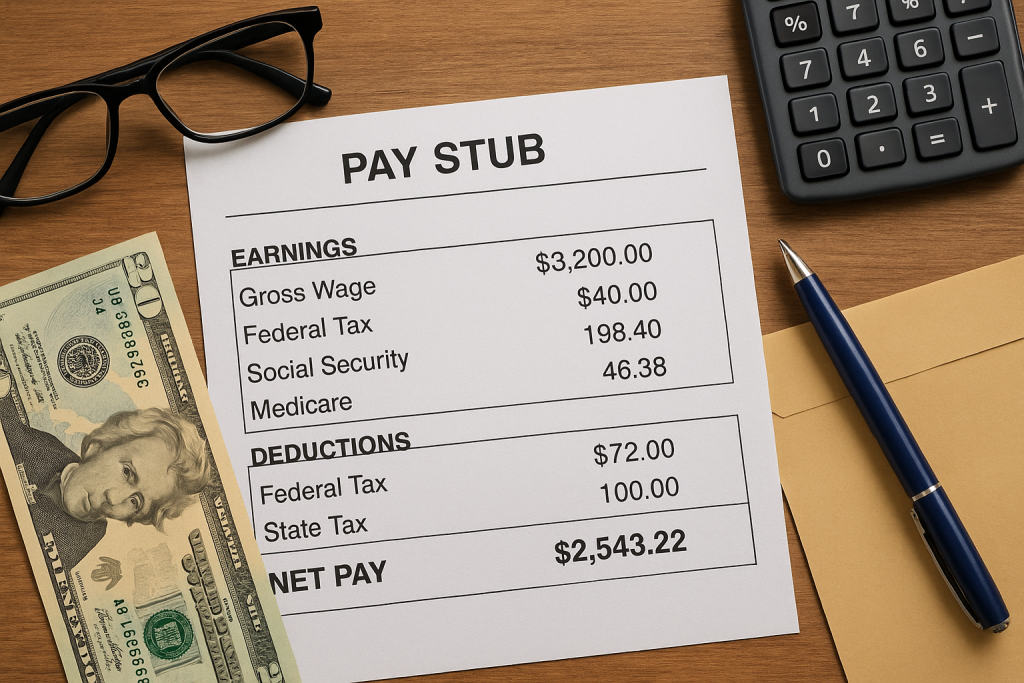
Your paycheck can look much smaller than the salary or hourly rate you agreed to when you were hired. That difference is not necessarily a problem, but it is important to know where every dollar went. When you read pay stub information carefully, you can confirm your hours, spot tax withholding, understand benefit costs, and catch payroll mistakes before they become harder to fix.
A pay stub is more than a receipt for your wages. It is a running record of what you earned, what was withheld, what your employer contributed on your behalf, and what actually reached your bank account. Understanding it can also make it easier to build a realistic budget, prepare for taxes, and decide whether workplace benefits fit your needs.
This guide breaks down the most common sections of a U.S. pay stub, explains the difference between gross and net pay, and gives you a practical process for reviewing each paycheck with confidence.
Contents
- 1 Why It Matters to Read Pay Stub Information Regularly
- 2 Make Smarter Money Moves
- 3 How to Read Pay Stub Sections From Top to Bottom
- 4 Start With Gross Pay, Hours, and Earnings Codes
- 5 Understand Tax Withholding Before You Read Pay Stub Net Pay
- 6 Separate Mandatory Withholding From Voluntary Deductions
- 7 Benefits and Employer Contributions May Not Reduce Your Paycheck
- 8 Find Net Pay and Match It to Your Deposit
- 9 A Practical Five-Minute Pay Stub Review Routine
- 10 What to Do When a Pay Stub Looks Wrong
- 11 Common Pay Stub Mistakes That Can Hurt Your Budget
- 12 Frequently Asked Questions
- 12.1 What is the difference between gross pay and net pay?
- 12.2 Why is my take-home pay lower than I expected?
- 12.3 Can an employer make deductions from my paycheck?
- 12.4 How often should I check my pay stub?
- 12.5 Does a retirement contribution on my pay stub mean I am getting an employer match?
- 12.6 What should I do if my hours or pay rate are incorrect?
- 13 Use Your Pay Stub to Make Better Money Decisions
Why It Matters to Read Pay Stub Information Regularly
Many people look only at the direct-deposit amount. While net pay is the number that affects your spending account, the details behind it can reveal errors or choices that affect your finances over time. A missing overtime payment, incorrect health insurance deduction, or outdated tax withholding selection can cost money or create an unpleasant tax surprise.
When you read pay stub details after each payday, you create a simple habit of checking that your employer paid you correctly. This is especially important if your schedule changes, you receive bonuses or commissions, you recently changed jobs, or you enrolled in benefits during open enrollment.
Your pay stub can help you answer practical questions, including:
- Did I receive the correct number of regular and overtime hours?
- Was my pay rate applied correctly?
- How much was withheld for federal, state, and local taxes?
- What am I contributing to health insurance, retirement, or other benefits?
- How much have I earned and paid in taxes so far this year?
- Does my bank deposit match the net-pay amount?
Checking these items does not require advanced math. It requires knowing what each label means and comparing the numbers to your own records.
How to Read Pay Stub Sections From Top to Bottom
Formats vary by employer and payroll provider, but most pay stubs contain the same core categories. Some are delivered on paper, while others appear in an employee portal or payroll app. Start with the identifying information, then move through earnings, taxes, deductions, and net pay.
Employee, employer, and pay-period details
The top portion usually identifies you and your employer. It may include your name, employee ID, department, work location, and the pay date. It should also state the pay period, such as March 1 through March 14, rather than only the date the money was deposited.
The pay period matters because it tells you which workdays are included. If you worked extra hours near the end of a pay cycle, they may appear on the next paycheck depending on your employer’s payroll cutoff. Before assuming an omission, compare your work dates with the period listed on the stub.
Current amounts and year-to-date amounts
Most pay stubs show two columns. “Current” or “this period” refers to the paycheck you just received. “Year to date,” often shortened to YTD, is the total from the beginning of the calendar year through the current payroll date.
YTD figures are valuable when you read pay stub records throughout the year. They show your cumulative wages, taxes, retirement contributions, and deductions. Near tax time, those totals can help you compare your final pay stub with the Form W-2 your employer provides.
Start With Gross Pay, Hours, and Earnings Codes
Gross pay is your earnings before taxes and other deductions come out. For hourly workers, it is typically based on hours worked multiplied by the applicable hourly rate. For salaried employees, it is often a fixed amount each pay period, although bonuses, commissions, paid leave, or unpaid time off can change it.
To read pay stub earnings correctly, look for line items rather than focusing only on the total. Common labels include regular pay, overtime, holiday pay, sick pay, vacation pay, bonus, commission, shift differential, reimbursement, and retroactive pay. Each line may have its own rate and number of hours.
For example, suppose a hypothetical employee earns $22 an hour and is paid every two weeks. During one pay period, she works 76 regular hours and 6 overtime hours. If overtime is paid at time and a half, her earnings could appear as:
| Type of earnings | Calculation | Gross amount |
|---|---|---|
| Regular pay | 76 hours × $22 | $1,672 |
| Overtime pay | 6 hours × $33 | $198 |
| Total gross pay | $1,672 + $198 | $1,870 |
If her stub shows only 74 regular hours, that does not automatically prove an error. She should first check her timecard, the pay-period dates, unpaid meal-break rules, and whether two hours were moved to another payroll cycle. If the records still do not match, she should contact payroll promptly and keep copies of her schedules and time records.
Employees covered by federal wage-and-hour rules may be entitled to overtime pay after more than 40 hours in a workweek, though exemptions and state rules can affect the outcome. The U.S. Department of Labor explains the core requirements under the Fair Labor Standards Act. Job title alone does not determine whether someone is exempt from overtime.
Understand Tax Withholding Before You Read Pay Stub Net Pay
After gross earnings, tax withholding is often the largest category on a pay stub. These amounts are generally sent to government agencies by your employer. They are not the same as optional benefit deductions, although all of them reduce the amount you receive on payday.
Federal income tax withholding
Federal income tax withholding is an estimate of the federal income tax you may owe for the year. The amount can depend on your wages, pay frequency, and the Form W-4 information you gave your employer. It may change after a raise, bonus, change in filing status, or adjustment to your W-4.
Withholding is not your final tax bill. When you file a federal return, your actual tax is calculated using your total income, deductions, credits, and other tax details. If too much was withheld, you may receive a refund; if too little was withheld, you may owe money.
If the federal withholding on your pay stub looks unexpectedly low or high, consider using the IRS Tax Withholding Estimator. It can help you decide whether to update your W-4, particularly after a major life or income change.
Social Security and Medicare taxes
You will usually see separate lines for Social Security and Medicare taxes. Together, these are often called FICA taxes. Employers generally withhold these payroll taxes from employee wages and also pay an employer share. The calculations and wage limits can change under federal law, so do not assume an identical amount will apply to every paycheck or every worker.
When you read pay stub deductions, remember that Social Security and Medicare taxes are usually separate from federal income tax. A paycheck may show small federal income-tax withholding because of your W-4 details while still showing significant FICA withholding.
State and local income taxes
Depending on where you live and work, your pay stub may include state income tax, local income tax, or both. Rules differ widely. Some states do not impose a broad individual income tax, while some cities, counties, or school districts have local payroll taxes.
If you moved, started working remotely from another state, or work across state lines, review these entries closely. Payroll taxes can become more complicated in those situations, and a tax professional may be helpful if your residence and work locations create conflicting obligations.
Separate Mandatory Withholding From Voluntary Deductions
The deductions section explains why gross pay and take-home pay differ. Some amounts are required by law or court order. Others are choices you made during hiring, benefits enrollment, or retirement-plan enrollment. Learning to read pay stub deductions line by line makes your compensation package easier to evaluate.
Common voluntary deductions include:
- Medical, dental, and vision insurance premiums
- Retirement-plan contributions, such as a 401(k) or 403(b)
- Health savings account or flexible spending account contributions
- Life or disability insurance premiums
- Union dues or professional association fees
- Charitable workplace-giving contributions
- Transit, parking, or other employment-related benefits
Mandatory deductions may include tax withholding, wage garnishments, child-support orders, or certain employee repayments allowed under applicable law. If you see a deduction you do not recognize, do not ignore it. Ask payroll for the name of the plan, the authorization date, the deduction frequency, and whether the amount is pre-tax or after-tax.
Pre-tax versus after-tax deductions
A pre-tax deduction generally reduces the wages used for at least some tax calculations. Traditional 401(k) contributions and certain health-benefit contributions are common examples, but tax treatment varies by benefit. An after-tax deduction comes from pay after applicable taxes have been calculated.
This distinction matters because two deductions of the same dollar amount can affect take-home pay differently. A $100 traditional 401(k) contribution does not necessarily reduce net pay by a full $100 if it lowers taxable wages for certain taxes. By contrast, a $100 after-tax contribution generally reduces take-home pay by $100.
Do not assume every retirement contribution is pre-tax. Roth 401(k) contributions are typically made after federal income taxes are calculated, though payroll treatment can be nuanced. Your benefits materials and payroll department can clarify the treatment used by your plan.
Benefits and Employer Contributions May Not Reduce Your Paycheck
Some pay stubs include an “employer paid” or “employer contribution” section. These figures can be useful, but they are not deductions from your paycheck. They may show your employer’s share of health insurance premiums, retirement-plan matching contributions, payroll taxes, or employer-paid insurance coverage.
This section helps you understand the broader value of your compensation. For instance, a hypothetical employee might pay $140 per paycheck for health coverage while the employer contributes $310. The employee’s deduction reduces net pay, while the employer contribution does not appear as money deposited into the employee’s account.
When you read pay stub benefits information, compare the deduction with your enrollment confirmation and any benefit-election documents. A new medical plan, a dependent added to coverage, or a change in retirement contribution rate can legitimately alter your pay. Still, the amount should match what you selected.
It is also smart to review employer retirement contributions separately from your own deposits. A match may be deposited on a different schedule than payroll contributions, and it may have vesting rules. “Vesting” means the conditions you must meet before employer-contributed money is fully yours if you leave the job.
Find Net Pay and Match It to Your Deposit
Net pay, sometimes labeled “net earnings,” is the amount left after taxes and deductions are subtracted from gross pay. This is usually the number sent by direct deposit, issued by check, or loaded onto a payroll card. Net pay is the figure most useful for day-to-day cash-flow planning.
A basic calculation looks like this:
Gross pay − taxes − deductions = net pay
For a hypothetical biweekly paycheck, an employee may have $2,400 in gross pay, $510 in combined tax withholding, and $290 in benefit and retirement deductions. Net pay would be $1,600. That does not mean the employee “lost” $800 in a simple sense: some of it went to taxes, some paid for insurance, and some may have gone into retirement savings.
When you read pay stub totals, match net pay to your bank transaction. If you use split direct deposit, your pay may be divided among checking, savings, and other accounts, so the amount in one account will not equal total net pay. Review the deposit-allocation details in your payroll portal before reporting a discrepancy.
Understanding the difference between salary and spendable income can also improve your budget. A plan built around gross pay can cause shortfalls because rent, groceries, loan payments, and other bills must be paid from net pay. For help organizing that number, use the approach in this guide to analyzing monthly expenses and cutting unnecessary costs.
A Practical Five-Minute Pay Stub Review Routine
You do not need to audit every code on every paycheck, but a brief review is worthwhile. The best time to read pay stub records is soon after payday, when your hours, schedule, and benefit changes are still easy to remember.
- Confirm the pay period and pay date. Make sure the dates cover the work you expected to be paid for.
- Check hours, rates, and earnings lines. Compare regular hours, overtime, commissions, paid time off, and bonuses with your own records.
- Review deductions for changes. Look for new insurance premiums, retirement contributions, wage garnishments, or unfamiliar labels.
- Compare net pay with your bank deposits. Account for any split deposit instructions or payroll-card transfers.
- Save the record. Download electronic stubs or store paper copies in a secure place, especially if you may need to verify income for a loan, rental application, tax filing, or benefit claim.
Keep your own simple log if your pay varies. For hourly work, record workdays, start and end times, breaks, approved overtime, tips where applicable, and paid leave. For commission-based work, keep copies of sales reports and commission-plan documents. Your records make it easier to explain a possible error clearly.
For workers trying to stabilize cash flow, net-pay awareness can support small but meaningful savings habits. After you know what reliably reaches your account, you can decide whether an automatic transfer to a high-yield savings account with manageable fees fits your budget.
What to Do When a Pay Stub Looks Wrong
Payroll errors can happen, particularly after a pay-rate change, job transfer, schedule adjustment, benefit enrollment, or leave of absence. A mismatch does not always mean your employer acted improperly, but it should be investigated promptly. The sooner you raise the issue, the easier it may be to correct.
Before contacting anyone, gather the relevant details: the pay stub, pay-period dates, timecard, work schedule, employment agreement or offer letter, and benefit-election confirmation. Then identify the specific problem. “My paycheck seems low” is harder to investigate than “My stub lists 72 regular hours, but my approved timecard shows 80 hours for March 1 through March 14.”
Use a clear sequence:
- Review your payroll portal and timekeeping records for an explanation.
- Contact payroll or your manager in writing, with the dates and amounts involved.
- Ask when you can expect a response and whether a corrected payment is possible.
- Keep copies of your communications and corrected documents.
- Escalate through your employer’s HR process if the issue remains unresolved.
Be particularly careful with changes to bank details, withholding forms, and benefit elections. Payroll scams sometimes involve fraudulent requests to redirect direct deposits. Use your employer’s verified HR or payroll system rather than changing sensitive information through an unexpected email or text message.
Also check your Social Security earnings record periodically. Your reported earnings can affect future benefit calculations, and the Social Security Administration explains how to access your record through a personal my Social Security account.
Common Pay Stub Mistakes That Can Hurt Your Budget
The most common mistake is treating a stated annual salary as if it were disposable income. A $60,000 salary does not mean $5,000 arrives in your bank account every month. Taxes, health coverage, retirement contributions, and pay frequency all affect the amount available for bills.
Another mistake is failing to update withholding after a meaningful life change. Marriage, divorce, a second job, freelance income, a new child, or changes in household income can all affect whether your withholding remains appropriate. Checking your W-4 does not guarantee a particular tax outcome, but it can prevent you from relying on outdated assumptions.
Some employees also stop reviewing stubs after the first few months in a job. That can make it harder to notice a gradual issue, such as a benefit deduction that continued after coverage ended or a retirement contribution rate that was changed unintentionally.
Finally, do not rely only on annual documents. A W-2 is important, but reviewing each pay stub lets you address a problem in the same pay period instead of discovering it after the year is over. If unpredictable pay makes it difficult to save, building an emergency fund while living paycheck to paycheck can provide a starting framework.
Key takeaway: Your pay stub is one of the most useful documents for understanding your cash flow. A few minutes of review can help you confirm that your earnings, taxes, deductions, and direct deposit all line up.
Frequently Asked Questions
What is the difference between gross pay and net pay?
Gross pay is what you earned before taxes and deductions. Net pay is what remains after payroll taxes, income-tax withholding, insurance premiums, retirement contributions, and other deductions are taken out. Net pay is generally the amount deposited into your account, although split direct deposit can send it to more than one destination.
Why is my take-home pay lower than I expected?
Your take-home pay may be lower because of taxes, health insurance, retirement contributions, unpaid time off, benefit changes, or a lower number of paid hours. To read pay stub details accurately, compare the current paycheck with the prior one and identify which specific line item changed. Then compare it with your schedule and benefit elections.
Can an employer make deductions from my paycheck?
Yes, employers can withhold required taxes and may take authorized deductions for benefits, retirement plans, or other agreed items. Certain other deductions may be governed by federal or state law, employment agreements, or court orders. If you do not recognize a deduction, ask payroll for a written explanation and documentation showing why it was taken.
How often should I check my pay stub?
Review it every pay period, especially if you are paid hourly, receive overtime, earn commissions, or recently changed benefits or tax withholding. Once you understand the format, the review can take only a few minutes. At minimum, check every line carefully after a raise, bonus, leave, job change, or enrollment change.
Does a retirement contribution on my pay stub mean I am getting an employer match?
No. A line showing your 401(k) or 403(b) deduction usually reflects your own contribution. An employer match may appear separately in an employer-contribution section, may be deposited later, or may be visible only in your retirement account. Review your plan documents to understand matching rules, eligibility, and vesting requirements.
What should I do if my hours or pay rate are incorrect?
Act quickly and document the issue. Save your pay stub, timecard, schedule, and any records showing the agreed pay rate. Contact payroll or your manager with the specific pay-period dates, hours, and amount you believe are wrong. When you read pay stub records soon after payday, you are more likely to resolve discrepancies while records are readily available.
Use Your Pay Stub to Make Better Money Decisions
Knowing how to read pay stub details gives you a clearer view of your real income, not just the number listed in an offer letter or job posting. Start with gross earnings, verify hours and pay rates, separate taxes from benefit deductions, and confirm that net pay matches your deposit. Over time, the year-to-date totals can also help you prepare for taxes and monitor retirement contributions.
Your next step is simple: pull up your most recent pay stub today and compare its hours, deductions, and net pay with your own records. Then explore more Financial Flow Now guides to turn that clearer paycheck picture into a stronger spending and savings plan.

The FinancialFlowNow Editorial Team creates practical educational guides on debt, credit, saving, retirement, and long-term wealth. Our goal is to explain complex financial topics clearly and help readers make more confident money decisions. Content is provided for educational purposes and is not individualized financial advice.