
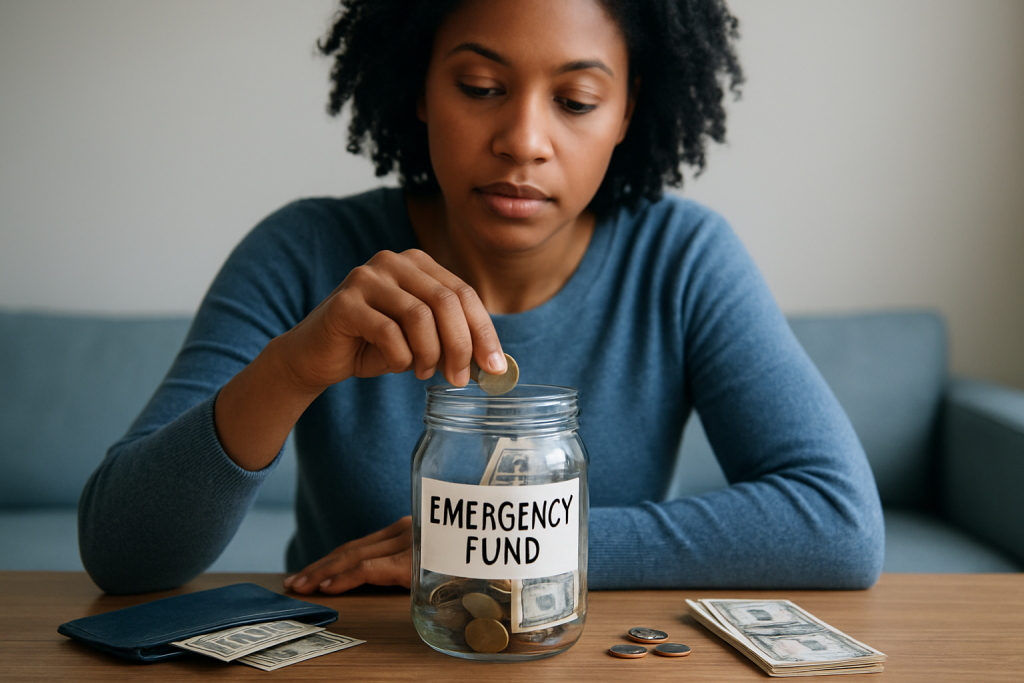
When every paycheck already has a job before it reaches your bank account, saving can feel unrealistic. Rent, groceries, utilities, debt payments, transportation, and family needs may leave little or nothing behind. But learning how to build emergency fund savings while living paycheck to paycheck is less about finding a huge amount of extra money and more about creating a small, repeatable system.
An emergency fund is money set aside for genuine financial surprises: an urgent car repair, a medical bill, reduced work hours, a broken appliance, or an unexpected trip to help family. Without savings, these events often end up on a credit card, payday loan, or overdue bill. That can turn a temporary problem into a long-term debt burden.
You do not need to save several months of expenses immediately. The practical goal is to build emergency fund momentum, starting with the first $100, then $500, then a larger cushion that fits your situation. This guide explains how to set a realistic target, find small amounts of money without relying on extreme deprivation, protect savings from everyday spending, and keep moving forward when life is expensive.
Contents
- 1 Why an Emergency Fund Matters When Money Is Tight
- 2 Make Smarter Money Moves
- 3 Set a Starting Goal That Fits Your Current Reality
- 4 Build Emergency Fund Savings Before Trying to Do Everything at Once
- 5 Find Small, Repeatable Amounts in Your Budget
- 6 Use a Paycheck-by-Paycheck Savings System
- 7 Keep Your Emergency Money Safe, Separate, and Accessible
- 8 Know When to Use the Fund and How to Rebuild It
- 9 Increase Income Carefully When Cutting Costs Is Not Enough
- 10 Common Mistakes That Can Slow Your Progress
- 11 Build Emergency Fund Progress With a 30-Day Starter Plan
- 12 Frequently Asked Questions About Emergency Savings
- 12.1 How much should I save before paying off credit card debt?
- 12.2 Can I build emergency fund savings if I only have $10 per paycheck?
- 12.3 Where should I keep my emergency fund?
- 12.4 Should I use my emergency fund for a car repair?
- 12.5 What if I keep using my emergency fund for bills every month?
- 12.6 Is a tax refund a good way to start an emergency fund?
- 13 Conclusion: Start Small and Build Emergency Fund Protection Over Time
Why an Emergency Fund Matters When Money Is Tight
It may seem backward to save money when you have bills due or high-interest debt. Yet a small cash reserve can protect you from adding even more debt when an unavoidable expense appears. The first purpose of an emergency fund is not to make you wealthy. It is to give you options when something goes wrong.
When you build emergency fund savings, you create a barrier between a financial surprise and your credit card. Suppose your car needs a $350 repair so you can get to work. Without savings, you may charge it to a card and pay interest while trying to catch up. With $350 saved, the repair is still frustrating, but it does not automatically become a revolving balance.
This matters especially for households with irregular hours, gig income, seasonal work, single incomes, or limited paid leave. A financial cushion can help you cover a deductible, replace a work tool, buy groceries during a delayed paycheck, or keep utilities on while you solve a short-term income disruption.
An emergency fund is also emotional protection. Financial stress can push people toward rushed decisions, including borrowing from expensive lenders, skipping necessary medical care, withdrawing retirement savings, or putting essential expenses on high-interest credit cards. Having even a modest reserve can reduce the pressure to make a decision in panic.
What counts as a real emergency?
An emergency is generally an expense that is urgent, necessary, and unplanned. The exact definition will differ by household, but the following situations often qualify:
- A car repair needed to commute to work or handle family responsibilities.
- An urgent medical, dental, veterinary, or prescription expense.
- A job loss, cut in scheduled hours, delayed paycheck, or unpaid leave.
- A critical home repair, such as a broken water heater or unsafe plumbing leak.
- Emergency travel related to a serious family situation.
- Replacing an essential item, such as a refrigerator, phone needed for work, or required work equipment.
By contrast, annual subscriptions, holiday gifts, routine vehicle maintenance, vacations, and expected school expenses are not usually emergencies. They may be important, but they are predictable. Those expenses are better handled through separate sinking funds, which are savings categories for costs you know will eventually arrive.
The distinction matters because it helps you build emergency fund savings that remain available for true disruptions. If the account regularly pays for ordinary spending, it will never have the chance to grow.
Set a Starting Goal That Fits Your Current Reality
The familiar advice to save three to six months of expenses can be useful as a long-term goal, but it may feel discouraging when you are struggling to cover this month’s bills. Instead of treating that number as a starting line, use smaller milestones.
A workable sequence might look like this:
| Milestone | Purpose | Who it may help most |
|---|---|---|
| $100 to $250 | Small urgent expenses and bill timing problems | Anyone starting from $0 |
| $500 to $1,000 | Common car, medical, appliance, or travel surprises | Workers with relatively stable income |
| One month of essential expenses | A larger interruption in income or a major repair | Households with variable income or dependents |
| Three to six months of essential expenses | Extended job loss, illness, or serious financial disruption | Longer-term financial security planning |
Your first target should be meaningful enough to help but small enough that you believe you can reach it. For many people, $500 is a strong first milestone. If that still feels impossible, begin with $100. A smaller completed goal is more valuable than an ambitious goal that makes you quit after two weeks.
To build emergency fund savings with a clear purpose, calculate your essential monthly expenses. Include housing, basic utilities, groceries, transportation, insurance, minimum debt payments, medications, child care, and other obligations needed to keep your household functioning. Exclude optional spending for now.
For example, if your essential expenses are $2,400 per month, a one-month reserve would be $2,400. You do not have to reach that amount all at once. Saving $25 per week would add up to about $1,300 over a year before interest. A tax refund, work bonus, cash gift, or extra shift could accelerate the progress.
Choose a target based on your risk, not someone else’s timeline
People face different financial risks. Someone with a stable salaried job, strong health insurance, reliable public transportation, and no dependents may need a different cash target than a self-employed parent with an older car and variable income.
Your emergency savings target may need to be higher if you:
- Work freelance, on commission, or in seasonal employment.
- Are the only income earner in your household.
- Have children, pets, or family members who depend on you.
- Own an older vehicle or home with likely repair needs.
- Have a high insurance deductible.
- Could have difficulty finding replacement work quickly.
There is no shame in starting small. The goal is to build emergency fund reserves steadily while reducing the chance that ordinary setbacks become financial emergencies.
Build Emergency Fund Savings Before Trying to Do Everything at Once
When money is limited, every financial goal competes for the same dollars. You may need to pay down credit cards, save for retirement, catch up on bills, replace a vehicle, and prepare for a future move. Trying to make major progress on every goal at the same time can leave you overwhelmed.
A practical approach is to prioritize immediate stability first. If you have no cash reserve at all, focus on a starter fund while continuing to make at least the required payments on your debts and bills. Once you have a small cushion, you can direct more money toward high-interest debt, retirement contributions, or other goals.
This does not mean ignoring expensive debt forever. Credit card interest can be costly, and delinquent bills can create serious problems. But having no emergency cash at all often means each surprise is financed with more borrowing. A starter reserve can help stop that cycle.
Consider this hypothetical example. Maya has $900 in credit card debt at a high interest rate and no savings. She receives an extra $300 from a temporary weekend shift. Rather than sending every dollar to the card, she puts $150 into a separate savings account and applies $150 to the card balance. Her debt remains important, but she now has some protection if her tire goes flat or a prescription costs more than expected.
Once Maya reaches her first $500 savings goal, she may decide to direct most extra money to debt repayment while maintaining that cash buffer. If she uses the fund for a real emergency, she can rebuild it before returning to more aggressive debt payments.
If credit card balances are consuming your budget, review the patterns that created them without blaming yourself. Financial stress, income gaps, emergencies, and emotional spending can all play a role. Financial Flow Now’s guide to common reasons people fall into credit card debt can help you identify which pressure points need attention alongside saving.
When catching up on essentials comes first
If you are behind on rent, utilities, food, insurance, essential transportation, or required medical care, those urgent needs may need to come before savings. Contact creditors, landlords, utility companies, or service providers early to ask about payment arrangements, due-date changes, hardship programs, or available assistance.
A savings plan cannot solve a cash-flow crisis by itself. First, protect basic needs and prevent consequences that could make your situation worse, such as eviction, utility shutoffs, loss of insurance, or loss of transportation to work. Then use even small amounts to build emergency fund savings as your cash flow stabilizes.
Find Small, Repeatable Amounts in Your Budget
The most sustainable way to save is usually not a dramatic one-time cut. It is identifying a realistic amount you can transfer consistently. That amount may be $5, $15, $25, or $50 per paycheck. The number matters less than the habit and the fact that it does not force you to rely on debt for routine needs.
Start by looking at your actual transactions, not only the budget you wish you followed. Review the last one or two months of bank and card activity. Group spending into categories: housing, food, transportation, debt, health, child care, subscriptions, shopping, entertainment, and cash withdrawals.
If tracking every expense feels intimidating, begin with the categories most likely to contain flexible spending. Financial Flow Now’s guide on how to analyze monthly expenses and cut unnecessary costs can help you review spending without treating every purchase as a personal failure.
Look for “leaks” without cutting necessities
Budget cuts should not mean skipping meals, avoiding medication, or canceling insurance you need. Focus first on spending that is optional, duplicated, or providing less value than it costs. Examples may include unused subscriptions, delivery fees, impulse purchases, convenience-store trips, automatic renewals, or dining out more often than you intended.
Suppose you identify these monthly changes:
- Cancel one unused streaming service: $12 per month.
- Bring lunch from home twice a week: $40 per month.
- Pause a shopping app’s automatic reorder: $18 per month.
- Choose grocery pickup to avoid unplanned aisle purchases: $30 per month.
That is $100 per month. In five months, it could help you build emergency fund savings of $500, assuming no withdrawals and no changes in income. You do not need to make every possible cut. You need a plan you can maintain.
Impulse spending is not always about poor discipline. Advertising, one-click checkout, boredom, stress, and social pressure can make small purchases feel harmless until they accumulate. If online shopping frequently disrupts your plan, consider removing stored card information, unsubscribing from retail emails, waiting 24 hours before nonessential purchases, or keeping shopping apps off your phone.
Reduce bills where possible, then save the difference
Some savings opportunities require a phone call or comparison shopping rather than ongoing sacrifice. Review insurance premiums, internet plans, cell phone service, bank account fees, and subscriptions at least once a year. Ask whether there is a lower-cost plan that still meets your needs.
If you reduce a bill by $20 per month, automate a $20 transfer to savings instead of allowing that money to disappear into general spending. This is a key way to build emergency fund savings without feeling like your lifestyle has changed dramatically.
Be careful with choices that create larger risks. For example, raising an insurance deductible may lower your premium, but it also means you need more cash available after a claim. Do not cancel coverage or choose a plan you cannot use simply to free up a few dollars today.
Use a Paycheck-by-Paycheck Savings System
Monthly budgeting works well for some households, but it can be difficult when bills are due at different times or your income changes from week to week. A paycheck-based plan often feels more practical because it assigns money based on when you actually receive it.
Start with a simple list of your next paycheck amount and every expense due before the following paycheck. Include the exact due date, minimum amount due, and whether the bill is automatic. Then decide what can be transferred to savings after essential obligations are covered.
For example, Jordan is paid every other Friday and takes home $1,400 per paycheck. From the first paycheck, Jordan needs to cover $750 for rent, $210 for groceries, $120 for transportation, $90 for utilities, $75 for a debt minimum, and $50 for other essentials. That leaves $105. Jordan might transfer $25 to emergency savings, leave $50 as checking-account breathing room, and use the remainder for flexible expenses.
On the next paycheck, the mix of bills may be different. The goal is not for Jordan to save the exact same amount every time. The goal is to build emergency fund savings whenever there is room, while avoiding overdrafts or missed essentials.
Automate a small transfer, but make it flexible
Automatic transfers remove the need to make a fresh decision every payday. You can schedule a transfer for the day after your paycheck usually arrives, placing money into a separate savings account before it gets spent elsewhere.
Start with a conservative amount. If $20 per paycheck feels safe, automate $20. After two or three months, reassess. If your checking account stays stable, increase it to $25 or $30. If the transfer repeatedly causes overdrafts or forces you to use a credit card for groceries, reduce it temporarily and fix the underlying cash-flow issue.
Automation should support your finances, not create another problem. A flexible system recognizes that some months include car registration, school expenses, holidays, insurance renewals, or lower work hours.
Use irregular income strategically
Tax refunds, overtime pay, bonuses, cash gifts, side work, rebates, and sold household items can provide a boost. Before spending an unexpected payment, decide on a percentage to save. You might send 25%, 50%, or even 75% to your emergency account depending on your current needs.
For instance, if you receive a $600 tax refund and have no savings, directing $300 to your reserve can move your plan forward quickly. The remaining amount could cover overdue expenses, debt, required maintenance, or a planned purchase. The point is to make a deliberate choice instead of letting the entire windfall disappear.
People with fluctuating income may find it useful to save more during higher-income months and reduce transfers during slower periods. That approach can still build emergency fund reserves over time without demanding the same contribution every month.

Keep Your Emergency Money Safe, Separate, and Accessible
An emergency fund should be available when you need it, but not so convenient that it becomes spending money. For most people, a separate savings account at a bank or credit union is a practical place to start.
Keeping the money separate from checking creates a small barrier before spending it. You can see that the account is reserved for emergencies rather than treating it as part of your everyday balance. Consider naming the account “Emergency Fund” if your institution allows account nicknames.
A savings account is usually more appropriate than investing emergency money in stocks, cryptocurrency, or other volatile assets. Investments can fall in value at exactly the moment you need cash. Emergency savings are designed for stability and access, not for maximizing returns.
When choosing a bank account, consider monthly fees, minimum balance requirements, transfer times, and access rules. Deposits at FDIC-insured banks are protected up to applicable limits, and the FDIC’s deposit insurance resources explain how that coverage generally works. Credit unions may offer similar federal share insurance through the National Credit Union Administration.
How much access is too much?
You want emergency money available within a reasonable time, but you do not necessarily need it in the same account as your debit card. A separate savings account at your regular bank may allow transfers within minutes or a day. An account at another institution can add more friction, though transfers could take longer.
A balanced setup could include a small amount in your primary savings account for immediate needs and the rest in a separate, insured savings account. Avoid keeping a large amount of emergency cash at home, where it can be lost, stolen, damaged, or spent without records.
Do not use a certificate of deposit, retirement account, or stock brokerage account as your only emergency reserve. These choices can involve withdrawal restrictions, penalties, market risk, or processing delays. As you build emergency fund savings, simplicity is usually an advantage.
Know When to Use the Fund and How to Rebuild It
Saving money can create anxiety if you become afraid to use it. Remember that an emergency fund is meant to be used for actual emergencies. The goal is not to preserve a perfect balance while you go deeper into debt or ignore an urgent need.
Before withdrawing, use a quick three-part test:
- Is it necessary? Would delaying payment create harm, risk, or a serious problem?
- Is it urgent? Does it need to be handled now or very soon?
- Is it unplanned? Was this expense outside your normal budget and sinking funds?
If the answer is yes to all three, using savings is likely reasonable. A $450 emergency dentist visit, an essential car repair, or groceries during a short gap in work hours may qualify. A sale at a favorite store, concert tickets, or a predictable annual insurance bill generally does not.
Suppose you have saved $800 and your car needs a $500 repair to remain safe and reliable. Using the money is not a failure. You successfully avoided putting the entire expense on a high-interest credit card. Afterward, your new goal is to build emergency fund savings back from $300 to $800 over time.
Create a rebuild plan immediately
After using your fund, review what happened and make a simple recovery plan. You might temporarily pause extra debt payments, direct a portion of the next tax refund to savings, take one optional spending category down for a few months, or save any overtime income.
Do not assume the fund has to be restored in one month. If you used $400 and can save $40 per paycheck, rebuilding may take 10 paychecks. That is still progress. The important thing is to resume the habit before everyday spending takes over the available cash.
Also ask whether the expense was truly unpredictable. If your car is aging and needs frequent repairs, you may eventually need a separate vehicle-maintenance sinking fund. If annual medical deductibles are likely, a health-care reserve may be helpful. These categories protect your emergency fund from predictable costs.
Increase Income Carefully When Cutting Costs Is Not Enough
There is a limit to how much you can cut, especially when your budget already covers only essentials. If the numbers simply do not work, increasing income may be more effective than trying to eliminate every small comfort.
Potential options depend on your time, health, transportation, caregiving responsibilities, and local job market. They may include asking for extra shifts, applying for a higher-paying role, offering a service based on a skill you already have, selling unused items, taking temporary seasonal work, or using a side job for a specific short-term goal.
Be realistic about costs. A side gig can involve gas, car maintenance, taxes, equipment, child care, and time away from rest or family. Do not assume every dollar earned is available to save. Estimate the net amount after expenses before committing.
If you earn an extra $200 in a month from occasional work but spend $45 on fuel and supplies, you may have $155 available. You could use $100 to build emergency fund savings and reserve $55 for debt payments or an upcoming expense. A defined plan prevents extra income from quietly becoming extra spending.
For households living paycheck to paycheck, income growth can be as important as expense control. Financial Flow Now’s guide for people who live paycheck to paycheck offers additional ways to evaluate cash flow and create room for financial progress.
Protect yourself from costly “quick money” offers
Be cautious with payday loans, title loans, cash advances, and offers that require an upfront payment to access work. These products and scams can worsen a short-term shortage. Read terms carefully, verify employers and platforms independently, and avoid giving sensitive financial information to unknown contacts.
If a financial emergency is immediate, compare alternatives before borrowing. A payment arrangement, community assistance, employer advance program, credit union small-dollar loan, or help from a trusted support network may be safer than a high-cost lender. The Consumer Financial Protection Bureau’s consumer financial tools can help you understand common financial products and decisions.
Common Mistakes That Can Slow Your Progress
Building savings on a tight budget requires patience, and setbacks are normal. Still, a few common mistakes can make the process harder than it needs to be.
Waiting for the “perfect” time to start
Many people plan to save once they get a raise, finish paying off debt, move to a cheaper home, or receive a large refund. Those events may help, but they are uncertain. Starting with $5 or $10 today gives you a system that can grow when circumstances improve.
It is easier to build emergency fund savings after you have practiced the habit than to suddenly begin saving hundreds of dollars when your income rises. A small automatic transfer teaches your budget to operate without every available dollar.
Keeping savings in the checking account
If emergency money sits beside your grocery, gas, and entertainment money, it can be difficult to know what is truly available. A separate account makes your progress visible and reduces accidental spending.
Using credit as the emergency plan
A credit card may be useful in a genuine emergency, particularly if it avoids immediate hardship. But relying on credit as your only backup can be expensive. Interest, minimum payments, and a reduced available credit limit can make the next emergency harder to manage.
A small cash reserve gives you flexibility. You may still choose to use a card for convenience or rewards and then pay it off with savings, but the important point is having money available to cover the charge.
Saving aggressively while ignoring a harmful budget gap
If you transfer $100 into savings and then charge $100 of groceries because there is not enough in checking, the plan is not solving the problem. Adjust your savings amount until your core expenses are covered. Then look for income changes, bill reductions, or assistance options that improve the underlying budget.
Giving up after the first withdrawal
Emergency funds are supposed to be used. Needing the money does not mean you failed to build emergency fund savings. It means the account performed its intended job. Rebuild it gradually and use what you learned to plan for similar expenses in the future.
Build Emergency Fund Progress With a 30-Day Starter Plan
A clear short-term plan can make saving feel less abstract. This 30-day approach is designed for someone who has little or no emergency savings and needs a manageable starting point.
Week 1: Find your starting number
Check your checking and savings balances, upcoming bills, minimum debt payments, and essential expenses. Decide on a first target, such as $100, $250, or $500. Do not count money already needed for bills as emergency savings.
Choose one account for the fund. If possible, open or designate a separate savings account with no monthly maintenance fee. Write down what situations qualify as emergencies for your household.
Week 2: Identify one recurring savings source
Review recent transactions and find one expense to reduce, pause, or negotiate. Commit the full amount to savings. If you cancel a $15 subscription, transfer that $15 rather than allowing it to blend into general spending.
This is the week to build emergency fund momentum through a specific, visible change. A single recurring transfer is more useful than a vague promise to “spend less.”
Week 3: Set up the paycheck system
Look at your next payday and list expenses due before the following payday. Decide on a transfer amount that will not cause an overdraft. Automate it if possible, even if the amount is only $5 or $10.
If income is irregular, use a rule instead of a fixed transfer. For example, transfer 10% of any payment above your normal baseline, or save half of any overtime earnings after setting aside money for taxes and work costs.
Week 4: Plan for the next surprise
Review your progress. Did you save anything? Did an expense derail the plan? Did you discover a bill you had forgotten? Use that information to adjust rather than criticize yourself.
Set your next 30-day target and identify one predictable expense that should eventually have its own sinking fund. The first month is about building awareness and consistency. Repeating the process is how you build emergency fund strength over the long run.
Key takeaway: Your emergency fund does not need to begin with a dramatic deposit. It needs a clear purpose, a protected location, and a contribution plan you can repeat through ordinary months and difficult ones.

Frequently Asked Questions About Emergency Savings
How much should I save before paying off credit card debt?
For many people, saving a small starter amount, such as $500 or $1,000, before aggressively paying down credit card debt is practical. This reserve can prevent a car repair, medical bill, or income gap from going right back on the card. Continue making at least the required payments on all debts while you save. Once you have a starter cushion, direct more extra money toward high-interest balances while maintaining the fund for true emergencies.
Can I build emergency fund savings if I only have $10 per paycheck?
Yes. It may feel slow, but $10 per paycheck is a valid place to start. If you are paid every two weeks, that could total about $260 over a year before any extra deposits. The habit also prepares you to save more after a raise, tax refund, reduced bill, or additional work income. The important step is to build emergency fund savings without creating overdrafts or relying on new debt for basic needs.
Where should I keep my emergency fund?
A separate savings account at an insured bank or credit union is often a good choice because the money is stable and reasonably accessible. Consider an account without monthly fees and with transfer access that works for your needs. Avoid putting emergency savings entirely into stocks, cryptocurrency, or retirement accounts, because values can fluctuate and withdrawals may be restricted or costly. The goal is reliable access, not the highest possible return.
Should I use my emergency fund for a car repair?
Usually, yes, if the repair is necessary for safety, work, medical appointments, child care, or other essential responsibilities and was not already planned for. A repair that keeps your only reliable transportation running is a common emergency-fund use. After paying for it, make a plan to rebuild your savings. If car repairs happen regularly, consider adding a separate vehicle-maintenance sinking fund once your emergency reserve is more established.
What if I keep using my emergency fund for bills every month?
If withdrawals are happening monthly, your problem may be an ongoing income-and-expense gap rather than isolated emergencies. Review essential expenses, due dates, debt payments, and income timing. You may need to reduce or renegotiate bills, seek additional income, use available assistance programs, or change your paycheck-based budget. Continue trying to build emergency fund savings when possible, but focus first on making the regular monthly budget sustainable.
Is a tax refund a good way to start an emergency fund?
Yes. A tax refund can be an effective jump-start, especially if you currently have no savings. You do not have to save the entire refund. Consider assigning a portion to emergency savings, a portion to overdue essentials or high-interest debt, and a portion to a planned need. If you routinely receive a large refund, reviewing your withholding may help you receive more money throughout the year, but make changes carefully so you do not unexpectedly owe taxes.
Conclusion: Start Small and Build Emergency Fund Protection Over Time
Living paycheck to paycheck does not mean you are incapable of saving. It means your plan needs to be realistic, flexible, and focused on protecting essential needs. Start with a modest target, separate the money from everyday spending, automate a manageable amount, and use windfalls intentionally. When an emergency happens, use the fund without guilt and then rebuild it at a pace your budget can support.
The most important step is to build emergency fund habits before the next surprise arrives. Choose one action today: open a separate savings account, transfer your first $5 or $10, or review your recent spending to find one recurring expense you can redirect. For more practical ways to strengthen your financial foundation, explore Financial Flow Now’s financial freedom principles for building long-term security.

The FinancialFlowNow Editorial Team creates practical educational guides on debt, credit, saving, retirement, and long-term wealth. Our goal is to explain complex financial topics clearly and help readers make more confident money decisions. Content is provided for educational purposes and is not individualized financial advice.