
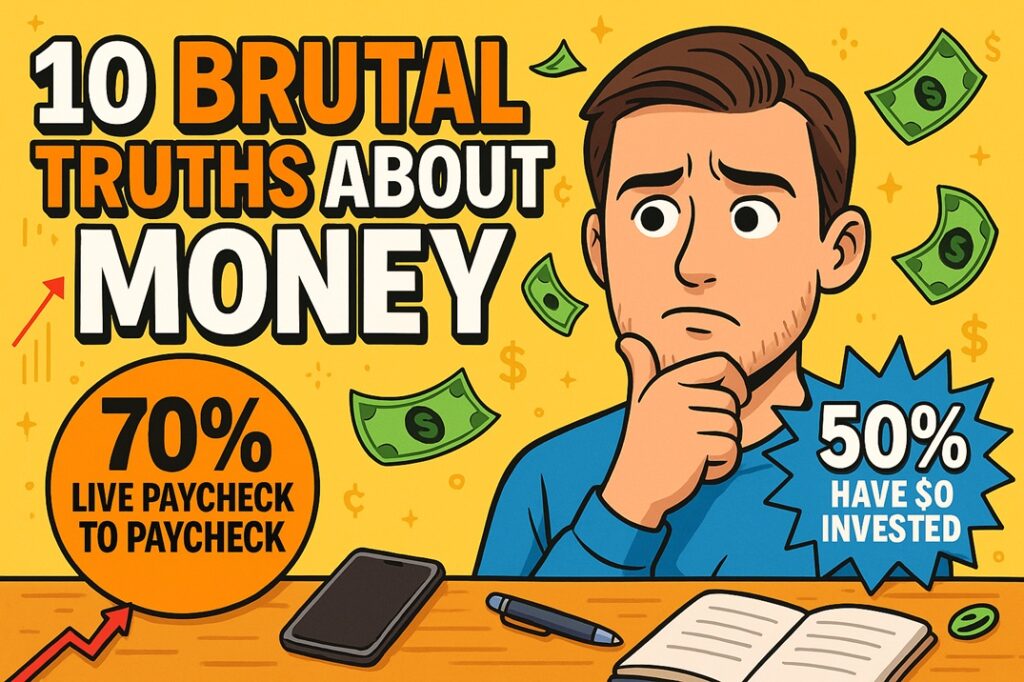
How poor people can build wealth is a question that demands brutal honesty. It’s not about blaming—it’s about awareness. If you’re struggling with money, the hard truth is that something in your mindset, strategy, or habits has to change. You’re not powerless. But to shift your financial future, you must first look directly at the realities most people avoid.
These aren’t theories. These are facts the wealthy already understand—and often use quietly. By learning them, applying them, and shedding excuses, anyone can start building momentum. Let’s explore 10 brutal, eye-opening truths that explain why most people stay poor—and how to break that cycle for good.
Contents
- 1 1. You Can Pay Little to No Taxes by Starting a Business
- 2 Make Smarter Money Moves
- 3 2. Making Money is About Solving Systems, Not Just Working Hard
- 4 3. Make Money While You Sleep—Or You’ll Always Be Limited
- 5 4. It Takes the Same Effort to Make $50K or $1 Million—If You Think Bigger
- 6 5. Ideas Are Worthless Without Ruthless Execution
- 7 6. Focus on Increasing Income Instead of Just Cutting Costs
- 8 7. $100 in Passive Income Is Worth More Than $1,000 in Worked Income
- 9 8. Over 50% of Your Income Should Go Toward Investments If You Want Out
- 10 9. Earning $1 Million/Year Is Not the Same as Being Wealthy
- 11 10. Never Borrow Money That Doesn’t Go Toward Making More Money
- 12 The Final Truths and the Path Forward
- 13 Conclusion: Knowledge Isn’t Power — Applied Knowledge Is
- 14 FAQ
1. You Can Pay Little to No Taxes by Starting a Business
It may sound unfair, but it’s how the system works. Employees are taxed before they ever see their income. Business owners, on the other hand, are taxed on what’s left after expenses. This is a fundamental advantage in how poor people can build wealth—legally minimizing taxes by shifting from W-2 income to business income.
Why This Matters
- Employees earn income → pay taxes → spend what’s left.
- Business owners earn income → spend on business expenses → pay taxes on what’s left.
What qualifies as business expenses? It can include:
- Travel (if related to business)
- Client meals and meetings
- Education, software, equipment
- Even vehicles or partial home office expenses
That’s why owning a business—even a side hustle—can be a game-changer. According to Investopedia, the tax benefits for small business owners are one of the strongest wealth-building levers available in the U.S. system.
2. Making Money is About Solving Systems, Not Just Working Hard
Hard work is necessary—but it’s not sufficient. Wealth is built by those who solve systems and manage resources. Working hard on a low-leverage task keeps you broke. Designing systems that deliver value at scale? That’s how poor people can build wealth strategically.
Example: The Lemonade Stand
An employee makes $10/hour selling lemonade. The owner of the stand earns $500/day by:
- Buying ingredients in bulk
- Hiring labor
- Setting up multiple stands
- Creating a marketing plan
It’s not about working more hours—it’s about solving more valuable problems. People who stay poor often try to “do more” instead of thinking “how can I make this easier, scalable, or automatic?”
3. Make Money While You Sleep—Or You’ll Always Be Limited
If your income is tied directly to your time, your wealth will always hit a ceiling. Passive income is not a luxury. It’s a necessity for those who want to escape paycheck-to-paycheck living. Learning how poor people can build wealth starts with building income streams that work even when you’re not.
What Counts as Passive Income?
- Dividends from stocks or REITs
- Royalties from books, music, or content
- Online courses or products
- Rental income
- Automated e-commerce
The wealthy invest early in systems that produce income without needing their constant labor. According to ConsumerFinance.gov, building even $100/month in passive income can dramatically reduce financial stress and increase freedom.
Learn real-world ideas to start today in our guide on Passive Income Ideas That Work in 2025.
4. It Takes the Same Effort to Make $50K or $1 Million—If You Think Bigger
This truth may shock you, but it’s backed by countless entrepreneurs and sales professionals. The effort to sell a $50/month service is often the same as selling a $5,000/month solution. The difference? Audience, pricing, positioning, and mindset.
Low Ticket vs. High Ticket Thinking
- Low ticket: Commodity products, low margins, high churn.
- High ticket: Specialized services, bigger impact, higher loyalty.
To go from survival to abundance, shift your attention toward higher-value problems. Whether it’s in sales, consulting, coaching, or creative work—the payoff is far greater when you raise your standards.
5. Ideas Are Worthless Without Ruthless Execution
Everyone has ideas. What separates the wealthy from the rest is relentless execution. A million-dollar idea is meaningless without the discipline to build, iterate, and persist. Execution is where wealth is made. This is a foundational lesson in how poor people can build wealth.
What Execution Looks Like
- Daily actions toward a specific result
- Tracking progress and adapting fast
- Working through resistance, boredom, and fear
- Finishing what you start
Google wasn’t the first search engine. Starbucks didn’t invent coffee. Facebook wasn’t the first social network. Execution is the difference between a dream and a business that prints money.
For more tips on money habits that stick, explore our guide: How to Analyze Your Monthly Expenses.
6. Focus on Increasing Income Instead of Just Cutting Costs
One of the most common mistakes people make when trying to improve their financial situation is obsessing over small savings—while ignoring the bigger opportunity: increasing their income. There’s a limit to how much you can cut. But there’s no cap on how much you can earn. That’s a critical shift in how poor people can build wealth.
The Scarcity Trap
Trying to save $2 here and $5 there can feel productive. But if you’re not earning enough to begin with, all the frugality in the world won’t lead to freedom. Worse, this mindset reinforces a focus on survival rather than growth.
How to Shift Focus Toward Income
- Learn high-income skills (coding, copywriting, design, etc.)
- Offer freelance services online or in your community
- Create and sell digital products or courses
- Apply for higher-paying roles or remote opportunities
- Launch a low-overhead service-based business
The goal isn’t to abandon responsible spending—it’s to understand that income growth provides far more leverage than coupon clipping or skipping lattes. And the fastest path to changing your financial reality lies in increasing your value to the marketplace.
7. $100 in Passive Income Is Worth More Than $1,000 in Worked Income
This truth might sound strange, but once you grasp it, your financial strategy will never be the same. Passive income gives you time freedom. Time is your most valuable asset—and passive income buys it back. If you’re serious about learning how poor people can build wealth, this principle is non-negotiable.
Why Passive Income > Active Income
- $1,000 earned from work requires time, effort, and taxes.
- $100 from a dividend, affiliate sale, or rental comes in automatically.
- Passive income compounds—you can stack multiple streams.
Over time, even small amounts of recurring passive income begin to change your mindset and reduce your dependence on traditional jobs. It’s not about getting rich fast—it’s about building freedom piece by piece.
Real-World Passive Income Examples
- Dividend stocks that pay monthly
- Automated dropshipping stores
- Rental properties managed by someone else
- Monetized YouTube channels or niche blogs
- eBooks or online courses that sell on autopilot
The earlier you start creating income that works without you, the sooner you stop being chained to the clock.
8. Over 50% of Your Income Should Go Toward Investments If You Want Out
This might sound extreme, but it’s the truth: if you want to escape the rat race, you need to put your money to work. Saving 5% or 10% won’t build freedom—it’ll just delay stress. The wealthy invest aggressively. And that’s a key insight into how poor people can build wealth: by living lean and investing heavy, at least for a season.
Investment Isn’t Optional
Most people treat investing like a luxury for when they “have extra.” That mindset guarantees you’ll never get ahead. You must flip the equation: invest first, spend what’s left—not the other way around.
Where Should the 50% Go?
- Stocks and ETFs: Long-term growth with compounding power
- Online business: Content, e-commerce, or services
- Real estate: Rental properties or REITs
- Self-education: Skills that multiply your earning potential
If your income is low, start smaller—but build the habit. Even $50 per month invested beats $0. As your income increases, scale the percentage up.
Learn how to reallocate spending and track your income goals in our step-by-step guide on How to Analyze Monthly Expenses.
9. Earning $1 Million/Year Is Not the Same as Being Wealthy
In a world of social media flash and six-figure influencers, it’s easy to think that high income = financial security. But here’s the reality: if you make $1 million and spend $980,000, you’re broke. True wealth is about freedom, ownership, and leverage—not flashy numbers.
Why High Income Can Be a Trap
- Taxes: Higher earners often pay more in absolute dollars.
- Lifestyle creep: Expenses rise with income unless you’re intentional.
- Stress: Big income often means more pressure and less time.
Don’t get hypnotized by gross numbers. Focus on net worth, cash flow, and flexibility. That’s how poor people can build wealth that actually lasts—and avoid the burnout that traps many high earners.
Measure What Matters
- How many months can you survive without working?
- Do you own appreciating assets or just expensive liabilities?
- Is your income protected by systems, insurance, or diversification?
Wealth isn’t about dollars—it’s about options. Build for those.
10. Never Borrow Money That Doesn’t Go Toward Making More Money
Debt isn’t the enemy. But misuse of debt is one of the main reasons people stay poor. Payday loans, credit cards, car payments for vehicles that don’t produce income—these are chains disguised as conveniences. The wealthy use debt to multiply capital. The poor use it to survive short term and suffer long term.
Good Debt vs. Bad Debt
- Good debt: Student loans (for in-demand fields), business loans, real estate mortgages that produce cash flow.
- Bad debt: Car loans, store credit cards, high-interest payday loans, impulse purchase financing.
Example: Payday Loan Trap
Some payday lenders in the U.S. and U.K. charge 200% to 400% APR. That means a $500 loan can turn into $2,000+ in fees and penalties within months. Borrowing without a return plan leads to financial quicksand.
Instead, use debt as a tool: if it doesn’t help you earn more money or acquire a value-producing asset, avoid it. That’s a critical rule in how poor people can build wealth—and avoid ruin.
What to Do Instead
- Build an emergency fund—even $500 makes a difference
- Sell unused assets before turning to credit
- Only finance purchases that produce ROI (return on investment)
- Use credit strategically, never emotionally
Freedom comes when you stop owing people for things that don’t increase your power.
For advice on avoiding predatory loans, visit ConsumerFinance.gov.
The Final Truths and the Path Forward
How poor people can build wealth depends on their willingness to see money for what it really is: a tool, not a savior. The truth is, many people underestimate how much control they can regain when they master their financial mindset and start using strategic principles — not just hard work — to grow. Below are the final brutal truths and what to do next.
9. A Million Dollars a Year Isn’t What It Used to Be
- Inflation erodes value: What felt like a dream income decades ago may now barely buy comfort in expensive cities.
- Taxation and lifestyle creep: High earners often lose 40% or more of their income to taxes, and overspending wipes out the rest.
- Lesson: It’s not about earning big — it’s about building a sustainable passive income system.
10. Never Borrow Money That Won’t Help You Make More Money
- Debt should be a tool: Smart borrowing funds investments and business opportunities — not impulsive purchases.
- Avoid toxic lenders: Predatory institutions often trap low-income borrowers with sky-high interest rates and hidden fees.
- Real example: Payday lenders charging over 200% APR are legal in many states. ConsumerFinance.gov offers tools to report abuse.

Caption: The tools to build wealth are all around you — if you know how to use them.
11. You Earn in Proportion to the Tools You Know How to Use
- Modern tools = modern wealth: In today’s world, tools like AI, smartphones, and automation platforms are more valuable than raw labor.
- Example: A phone can be a $1,000 entertainment device or a $100,000/year business tool — it depends on how you use it.
- Takeaway: Invest time in mastering tools that multiply your effort and output.
Conclusion: Knowledge Isn’t Power — Applied Knowledge Is
How poor people can build wealth isn’t a mystery — it’s a matter of choice, action, and strategy. You’ve now seen 10 brutal truths about money. The difference between staying stuck and building a legacy often comes down to which truths you apply today.
- Start a side hustle that solves a real problem.
- Study one tool deeply and turn it into income.
- Stop spending on what won’t generate returns.
- Invest more in assets than you save in your bank account.
Take a deep breath and know this: the journey may be hard, but the rewards are life-changing. Whether you’re escaping debt, building generational wealth, or just aiming to sleep peacefully at night, these principles can guide your transformation.
FAQ
Can someone really build wealth starting from nothing?
Yes. With discipline, access to information, and a long-term view, people from all backgrounds have built wealth. Focus on income-producing skills and reinvest wisely.
How much should I invest each month if I want to escape the rat race?
Ideally, aim to invest 30–50% of your income if possible. Start smaller if needed, but be consistent. Time in the market beats timing the market.
What’s the fastest way to create passive income?
There’s no true “fast” way — but the most scalable paths are affiliate marketing, digital products, and dividend-paying investments. See our full guide: Passive Income Ideas.
Remember, how poor people can build wealth is less about luck and more about leverage. Your next step can change your life.

The FinancialFlowNow Editorial Team creates practical educational guides on debt, credit, saving, retirement, and long-term wealth. Our goal is to explain complex financial topics clearly and help readers make more confident money decisions. Content is provided for educational purposes and is not individualized financial advice.